
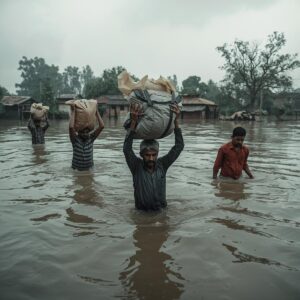

Every year, the floods in Pakistan do not only bring destruction, homelessness, and loss of property, but they also raise a very important legal question: Is the state only responsible for giving relief after the disaster, or can it also be held legally accountable? Article 9 of the Constitution of Pakistan guarantees the right to life, and Article 14 protects the dignity of man. This means that the state’s duty is not just to help after the disaster, but also to take preventive measures beforehand. Building dams, embankments, and drainage systems, controlling illegal constructions, and making proper disaster planning are all legal duties of the government. If these steps are ignored, it becomes a violation of fundamental rights.
Under the National Disaster Management Act, 2010, institutions like NDMA and PDMAs are responsible for prevention, preparedness, response, and rehabilitation. But in reality, these bodies often remain limited to rescue and relief only, while ignoring prevention. This failure amounts to a violation of their statutory duties. If negligence or misuse of funds is proven, then the state’s liability can also be established under the law of torts particularly negligence and nuisance. The courts of Pakistan have repeatedly declared that a safe environment and healthy living are part of the fundamental right to life. In Shehla Zia v. WAPDA (PLD 1994 SC 693) the Supreme Court held that the right to life is not only limited to physical existence, but also includes the right to a safe and healthy environment. Thus, if the government fails to perform its duties during floods, it can be held liable both constitutionally and civilly
The answer is therefore clear, the responsibility of the state is not limited to providing relief, but also extends to prevention and protection. Citizens can hold the government legally accountable through constitutional petitions, public interest litigation, and tort claims. The question that keeps arising during every flood crisis is this: Will Pakistan continue to remain a state that only reacts after the disaster, or will it transform into a proactive and legally responsible government that truly protects the fundamental rights of its people?