

The most dangerous changes to constitutional governance rarely happen overnight. They occur silently in times of crises where fear is a justification of what is otherwise foregone by law. One of the obvious examples of this danger are emergency powers. These authorities are mainly applicable during wars, epidemics, natural calamities, civil conflicts, or even security threats to the country. Once emergency powers are granted to the government, they make the executive capable of curtailing fundamental rights, ruling by ordinance or decree, limiting the role of judiciary and, most importantly, the use of military laws in civilian life. In theory, these powers are purely temporary, but in practice, if misused they often leave lasting marks on constitutional governance. When temporary powers turn into forced permanent powers, normal law can never be fully restored. This is the conflict between theory and practice that is explicitly apparent in the constitutional system of Pakistan. Article 232 of the Constitution of Pakistan provides that the President has the power to declare a temporary emergency in case the security of Pakistan is at risk due to war, foreign aggression or a severe internal unrest. In the event of such an emergency, the Federal Government and Parliament may take on greater powers over the provinces, but only with the approval of the parliament, and limited in time. In addition, Article 233 of the Constitution of Pakistan permits the emergency suspension of certain fundamental rights. The emergency powers in Pakistan are supposed to be allowed under special circumstances, however a concerning question remains: when emergency authority of the state is used over and again does it consider temporary, or it actually alters the normal constitutional order just silently?
The fact is that Constitutions can only place limits on emergency powers, but they cannot enforce them practically and it's not the duty of the Constitution to enforce the law. The responsibility for enforcing the law indeed lies with those who exercise state authority, namely the executive (government) and political leadership. If the executive tries to misuse these ad hoc powers as permanent authority for their personal gains, then this will definitely result in weakening the authority of the constitution. Whether these powers are temporary or permanent is heavily dependent on the conduct of those who exercise them. Giorgio Agamben, a prominent Italian philosopher, known for his political theories argues in his book State of Exception that “what is meant to be a temporary emergency response increasingly becomes a normal mode of governance, where extraordinary powers are relied upon in place of ordinary law.” This is where constitutional governance becomes crucial! A glance back at the history of Pakistan showcases the exploitation of these powers behind the veil of martial laws. While there is an extensive history, this article briefly illustrates three pivotal martial laws to facilitate better understanding. The first martial law was proclaimed on October 7, 1958, technically declared by Iskander Mirza then General Ayub Khan completed and formalized it and during this period the exceptional powers were abused for instance: opposition leaders were arbitrarily arrested, and civilians were tried by military courts for subversion. Given these circumstances, this normalized military intervention as a constitutional substitute. Then the second martial law was imposed on March 25, 1969, by Yahya Khan. During this time, emergency powers were misused even more than before as the first martial law had set a precedent: assemblies were dissolved without elections, East Pakistan leaders were arrested, and military operations in East Pakistan resulted in thousands of deaths. Even the courts were not allowed to question the martial law and this was an indication of blatant misuse of temporary power as absolute power. The third martial law was declared on July 5, 1977, by Zia-ul-Haq initially as a ninety-day operation. However, the disturbing fact is it was extended for nearly eight years during which the military handed down thousands of sentences, including death penalties, as in the Sahiwal case of 1984. This much extension of the period mirrors the concept of “exception to rule” in Pakistan's history.
All these actions were formalized as short term responses to national security, state survival, technocrat modernization, political instability, corruption and constitutional failure etc. But in reality, these martial law regimes were orchestrated prolonged attempt for personal gains and to consolidate power. These historical events left indelible scars on Pakistan’s Constitution, the effects of which are persistently visible in Pakistan’s constitutional governance today. They entrenched military dominance, institutional fragility despite partial reversals like 18th Amendment (2010), which removed certain constitutional distortions, for example removal of the Article 58(2)(b). This reform curtailed the President’s power to dissolve elected assemblies and restored parliamentary supremacy, thereby reinforcing the legislature and the parliamentary form of government.
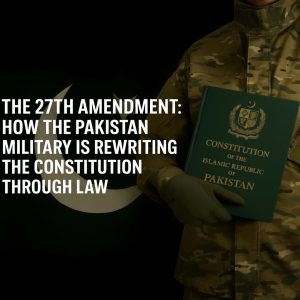
Notwithstanding these reforms, many constitutional provisions or their continuing effects still continues to exist, ultimately resulting in fostering instability, discrimination and hybrid civil-military rule in the country. These dynamics are clearly reflected in the recent constitutional developments in Pakistan , particularly the 27th Amendment to the Constitution of Pakistan, which despite facing resistance from the public and political parties, has passed and further entrenches military supremacy by granting lifelong immunities to senior military leadership. This amendment also raises serious concerns for judicial independence by envisaging the creation of a Federal Constitutional Court and restricting the Supreme Court’s jurisdiction over constitutional matters, including its Suo Moto powers. After this amendment passed, Justice Mansoor Ali Shah resigned from Supreme Court of Pakistan on 13th November 2025 stating in his resignation letter “The Twenty-Seventh Constitutional Amendment stands as a grave assault on the Constitution of Pakistan. It dismantles the Supreme Court of Pakistan, subjugates the judiciary to executive control, and strikes at the very heart of our constitutional democracy- making justice more distant, more fragile, and more vulnerable to power.” Even though no emergency situation exists and no martial law is in place, the provisions of the 27th Amendment demonstrate how extraordinary powers are being institutionalized under the guise of constitutional reform. All this reflects an ongoing attempt to normalize such interventions by presenting them as necessary for governance and stability.
A notable example of a country that used temporary powers granted during an emergency as temporary and did not exploit them for personal and political gains is Canada. In February 2022, the Canadian government activated the Emergencies Act. The emergency was revoked in just nine days once the immediate threats were resolved. This illustration demonstrates adherence to the temporary nature of the powers without extension for unrelated or self-serving purposes. Pakistan’s government must urgently need to focus on this issue and must guard against the exploitation of crises-era authority by government officials and military dominance behind the veil of constitutional amendments. Pakistan is a federal parliamentary democratic republic where executive power flows from legislature, and the core purpose of federation is to prevent the amalgamation of powers among legislature, executive and judiciary. As explained above, during emergencies, more powers are transferred to the governing authority, but if these powers are misused by extension, then this will culminate in eradicating the main objective of federation and this will also defeat the constitutional structure and leads to constitutional abuse.
A Constitution does not collapse when suspended in emergency, but when extraordinary power becomes an accepted mode of governance. Pakistan was founded on the promise of constitutional restraint and democratic order, not permanent exception cloaked as necessity. “There is no power on earth that can undo Pakistan” Quaid-e-Azam Muhammad Ali Jinnah.