
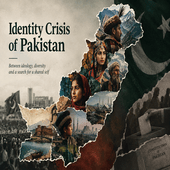
Pakistan, nearly eight decades after its creation, is continuously grappling with the question of what defines its identity. A state based on the Two-Nation Theory and shaped by the upheaval for a separate state for the Muslims of India. The identity crisis of Pakistan took birth right with its creation, where many argue it to be an Islamic state and many argue it to be a state of liberals and seculars, from Zia’s Islamization to Musharraf’s liberalization. At the same time, its rich ethnic diversity, from Pashtun to Punjabi and Baloch to Sindhi, and then smaller ethnicities like Pahari, Kalash, Gilgiti, Balti, Shina, Burusho, and Wakhi, raises a pressing question. Can a state so diverse rely on religion alone as the basis of a shared national identity?
The Ideology of Pakistan, the Two-Nation Theory, is based on the belief that Muslims of India must live in an independent Muslim state because they have a different culture, civilization, traditions, literature, language, religion, and way of life to distinguish themselves from other nations in India.
The claim that religion alone can serve as the basis for nationhood had existed uneasily, especially with the Punjabis and the Pakhtuns. On both sides of the border, the Punjabi language, traditions, and customs that have existed long before 1947 are the same: weddings, folklore, cultural dance, language, literature, and common heroes like Bhagat Singh and Rai Ahmad Kharral. The case with the Pashtuns is no different either. The only thing that differs between Punjabis on this and the other side is the religion, and this raises an important question: if culture, language, and social norms remain largely continuous, can religion alone sustain a distinct national identity?
This is not to dismiss the circumstances or the political anxieties of Muslims that led to the creation of Pakistan in India, but to question how the idea of Pakistan has evolved or failed to evolve since independence.
Over time, Pakistan’s been swinging between competing visions of itself. From General Zia-ul-Haq’s jihadi policies and creation of thousands of madaris, which many argue to be Islamic reforms, to General Musharraf’s gender and social reforms and empowerment of women, which many argue to be against Islamic values. These shifts, rather than answering the question of identity, reinforced ambiguity about the country’s identity.
This ambiguity extends beyond ideology into social and cultural hierarchies. Language, for instance, has often been politicized. Local languages have been marginalized in favour of Urdu and English, which was one of the reasons for the separation of East Pakistan, now Bangladesh. In schools, it isn’t allowed to speak the local language, nor is the local literature being taught. The forced dominance of English and Urdu reinforces class division and the perception of cultural superiority. Such dynamics make the idea of a unified national identity even harder and raise another question: whose culture is truly being represented?
The consequences of this complicated religious identity and socio-ethnic dynamics can be seen in politics and society. Competing narratives about what Pakistan should be- an Islamic or a secular state- all this continues to shape policy debates and educational frameworks, and this has contributed to the rise of Khilafah movements and other nationalist or separatist movements that claim to offer definitive answers.
None of this means that the ideology of Pakistan was inherently flawed; rather, it means that it became stagnant and didn’t evolve with time, remaining underdeveloped. To prosper ideologically or as a society, nations shouldn’t stay stagnant; rather, they should open the way for debates, constructive criticism, and open dialogue, moving beyond rigid boundaries and acknowledging the complexity of their own society.
Acknowledging the complexity of cultural diversity and of national identity is a need of the hour. Only then can a country begin to address whether it has a coherent identity, or is it willing to shape one that reflects its cultural diversity, ideological origins, and its social realities. Until Pakistan confronts this question with honesty and the seriousness it demands, the country’s identity crisis is likely to persist.